Techniques
Named moves across the art. Each technique page gathers videos tagged to it and links back to the positions where it shows up.
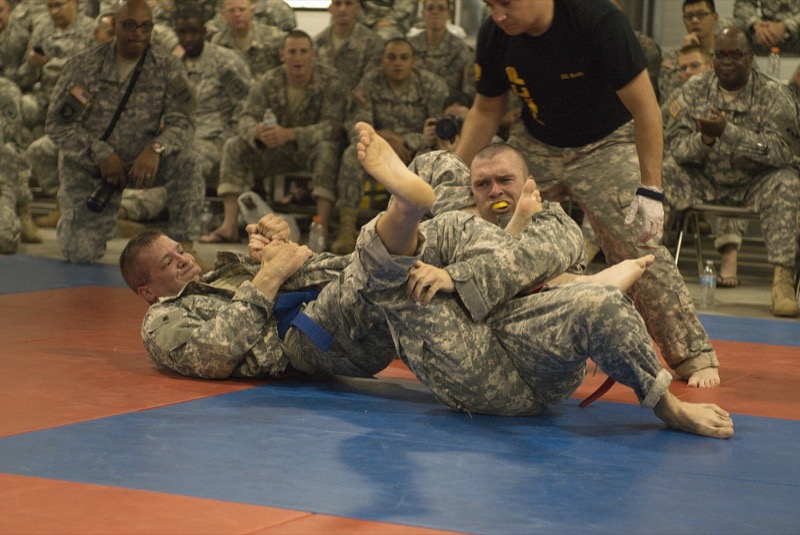
Arm bar at the 2013 Army Reserve Best Warrior Competition. Sgt. 1st Class Scott Turner. Public domain. Source
Submissions
- Americana A figure-four shoulder lock with the opponent's arm bent at 90 degrees and their hand pinned to the mat, usually from side control or mount. 9
- Anaconda Choke The mirror of the D'Arce: your arm goes under the neck and behind the far arm, usually finished with a roll from the front headlock. 6
- Arm Triangle Pinning one of the opponent's arms across their own neck with your head and shoulder, finished from mount or side control. 15
- Armbar Hyperextending the elbow by controlling the wrist and pinning the shoulder, with the hips as the fulcrum. Available from guard, mount, side control, knee on belly and the back. 36
- Armbar from the Back Trapping an arm that reaches back to defend the choke and rolling into a straight armlock from back control. 2
- Baseball Bat Choke Two collar grips stacked like hands on a bat, finished by spinning to north-south. Attacked from knee on belly, side control and bottom guard. 4
- Bow and Arrow Choke The strongest gi choke from the back: a collar grip and a pant grip pulled in opposite directions with your leg across the body. 4
- Brabo Choke A gi choke from top half guard using the opponent's own lapel fed under their arm and around the neck. 1
- Calf Slicer A compression lock that drives your shin into the opponent's calf while folding their leg, from the truck, lockdown or a turtle. 4
- Can Opener Pulling the head forward from inside closed guard to force the guard open. A neck crank that is illegal in many rule sets. 2
- Clock Choke A collar choke against the turtle where you walk around the head like the hands of a clock to tighten it. 5
- Collar Chokes from the Back Sliding collar, single wing and short chokes from back control using the gi. 3
- Cross Collar Choke Two deep collar grips, palms up or one palm down, that close the carotids by pulling the elbows to the mat. The fundamental gi choke from guard and mount. 10
- Crucifix Armbar Using the legs to hyperextend the arm trapped in the crucifix while the hands attack the neck. 4
- D'Arce Choke An arm-triangle from the front headlock: your arm threads under the opponent's near arm and across the neck, locked with your other bicep. 7
- Electric Chair The 10th Planet groin stretch (and sweep) from the lockdown, where the trapped leg is extended while the opponent is tilted over. 2
- Estima Lock A footlock invented by the Estima brothers that attacks the ankle from the inside, often while passing. 2
- Ezekiel Choke A choke using your own sleeve (or bare forearm in no-gi) fed behind the opponent's neck, finished from mount, inside guard or from the back. 5
- Guillotine Wrapping the neck from the front with the forearm across the throat. Finished standing, from guard or from the front headlock with high-elbow and arm-in variations. 10
- Heel Hook Rotating the heel to twist the knee from the saddle, 50/50 or outside ashi. Devastating, and only legal in no-gi and at brown/black belt in most rule sets. 25
- Japanese Necktie A front headlock choke and neck crank combining a D'Arce-style grip with a leg over the back. 2
- Kesa Gatame Armlock Trapping the far arm over the thigh and levering the elbow with the legs from scarf hold. 5
- Kimura A figure-four grip on the wrist and elbow that rotates the shoulder. Works as a submission, a sweep and a control system from almost every position. 18
- Kneebar Hyperextending the knee like an armbar for the leg, from the saddle, 50/50, top half guard or a turtled opponent. 2
- Lapel Chokes The family of chokes that feed the opponent's own lapel around their neck, mostly from lapel guards and the back. 4
- Loop Choke A single collar grip that loops around the neck as the opponent's head is pulled down, finished from guard, half guard or the front. 1
- Mounted Triangle Locking a triangle from mount or S-mount, usually when the opponent frames with an arm across their neck. 4
- North-South Choke A blood choke from north-south using your bicep and shoulder around the neck, made famous by Marcelo Garcia. 7
- Omoplata A shoulder lock using the legs, entered from guard when the opponent's arm goes across or under your leg. Often finishes as a sweep instead. 11
- Paper Cutter Choke A gi choke from side control with one hand deep in the far collar and the forearm cutting across the throat. 3
- Peruvian Necktie A front headlock choke where you sit back and throw your legs over the opponent's back and neck. 2
- Rear Naked Choke The blood choke from the back - one arm under the chin, the other locking behind the head. The highest-percentage finish in grappling. 13
- Rear Triangle Locking a triangle around the neck and one arm from back control when the opponent defends the rear naked choke. 3
- Straight Ankle Lock Hyperextending the ankle with the blade of the forearm under the achilles, usually from ashi garami or single-leg X. Legal for all adult belts in IBJJF. 14
- Toe Hold A figure-four grip on the foot that twists the ankle and knee. Finished from many entanglements and as a counter to leg lock defence. 1
- Triangle Choke Trapping the head and one arm inside a figure-four of your legs so the opponent's own shoulder closes the carotid arteries. 15
Sweeps
- 50/50 Sweep Coming up on top in 50/50 to score the sweep, usually by controlling the opponent's upper body and driving forward. 2
- Butterfly Sweep Lifting the opponent with a butterfly hook while falling to the side with an underhook or overhook. The core of butterfly guard. 9
- De La Riva Sweep The classic sweep from the DLR hook, pulling the far sleeve and ankle while pushing the hip to tip a standing opponent. 10
- Deep Half Basic Sweep The fundamental deep half reversal - trapping the leg and rolling through to come up on top. 4
- Dogfight The scramble position from half guard where both players are on their knees with an underhook and a whizzer. A launching pad for sweeps and back takes. 4
- Flower Sweep Swinging a leg like a pendulum while controlling the sleeve and pant leg to roll a kneeling opponent from closed guard. Chains directly with the armbar. 8
- Hip Bump Sweep Sitting up from closed guard, posting on a hand and bumping the hip into a kneeling opponent to roll them into mount. Combines with the kimura and guillotine. 7
- Homer Simpson Sweep Spinning underneath from deep half so the opponent's leg is loaded onto your shoulder and they topple backwards. 3
- John Wayne Sweep A half guard sweep that hooks the far leg and rolls the opponent over your body when they sit back to defend. 3
- Kimura Sweep Using the kimura grip as a lever to roll a kneeling opponent from closed guard or half guard. 4
- Kiss of the Dragon Rolling under from reverse De La Riva to come up behind the opponent for a sweep or the back. 4
- Knee Shield Sweeps Sweeps launched from the knee shield, using the shield to lift or tilt while controlling a sleeve or an ankle. 3
- Lasso Sweeps Using the lasso as a lever on the arm, combined with a DLR or foot-on-hip, to sweep kneeling and standing opponents. 7
- Lumberjack Sweep Grabbing both ankles when the opponent stands in your closed guard and driving your hips into their knees to topple them. 3
- Old School Sweep From underhook half guard, coming up to your knees and grabbing the far foot to sweep the opponent over. 5
- Peterson Roll The wrestling roll from a referee's-position style turtle that reverses an opponent driving from behind. 2
- Plan B Sweep When old school is blocked, switching to a knee-tap style reversal from the same underhook half guard position. 2
- Reverse De La Riva Sweeps Tilting sweeps from RDLR when the opponent postures up or tries to knee cut through the hook. 3
- Roll Under Sweep Rolling under a standing or upright opponent from half guard to take them over, usually into deep half or a leg entanglement. 2
- Scissor Sweep One shin across the belly and the other leg low, scissoring the legs while pulling the opponent's collar and sleeve to sweep them from closed or open guard. 5
- Sickle Sweep The partner of the tripod sweep - pushing the hip while sickling the far leg out from behind. 2
- Side Control Reversals Bridging, rolling and underhook-driven reversals that put you on top when the side control player over-commits. 4
- Single Leg X Sweeps Sweeping backwards, forwards or by standing up from single-leg X while controlling one leg. 8
- Spider Guard Sweeps Sweeps using the bicep control of spider guard - extending one arm while collapsing the other to tip the opponent over. 4
- Tomoe Nage and Overhead Sweeps Planting a foot in the hip and rolling backwards to throw a forward-leaning opponent over your head. 4
- Tripod Sweep Against a standing opponent: a foot on the hip, a hook behind the far knee and an ankle grip, pushing and pulling at once. 5
- Turtle Reversals Rolling or sitting through to reverse an opponent who is attacking your turtle. 3
- Waiter Sweep The deep half sweep where you hold the opponent's foot up like a waiter's tray and drive them over. 3
- Worm Guard Sweeps Sweeps that use the lapel wrapped around the opponent's leg as an unbreakable lever. 2
- Wrestling Up Coming up from seated guard to a single or double leg instead of sweeping from your back. The no-gi default against a standing passer. 5
- X-Guard Sweeps The sweeps from X-guard - extending the legs to stretch the opponent out, or standing up with their leg for a single leg finish. 12
Passes
- Backstep Pass Stepping the leg backwards over the opponent's leg to switch sides and pass, often landing in kesa or reverse half. 9
- Body Lock Pass Locking the arms around the waist from inside the guard and walking round the legs with chest pressure. 8
- Breaking Down the Turtle Dragging or rolling a turtled opponent onto their side or back to reach side control. 2
- Cartwheel Pass Cartwheeling over a supine opponent's legs when they retain guard in the middle. Flashy but effective against inversion-heavy guards. 3
- Double Under Pass Both arms under the legs, gripping the collar or hips, lifting and stacking to pass. 3
- Escaping Single Leg X Hiding the heel, weight placement and clearing the hooks to exit single-leg X before the leg lock. 8
- Escaping X-Guard Base, knee drop and leg extraction to survive and exit X-guard, turning it into a pass. 7
- Folding Pass Folding the opponent's knees to their chest and driving forward so their hips leave the mat and their frames collapse. 2
- Half Guard Passes The general family of half guard passes - crossface, underhook, flatten and free the knee. 9
- Hip Switch Pass Switching the hips to face the opponent's legs from top half guard to free the trapped knee. 2
- Knee Cut Pass Sliding one knee across the opponent's thigh to the mat while controlling the far side with a crossface or underhook. The most common pass in jiu-jitsu. 34
- Kneeling Guard Break Opening closed guard from the knees with a knee in the tailbone, a hip step back and elbow pressure on the thigh. 4
- Leg Drag Pass Dragging one of the opponent's legs across your hip and pinning it, leaving them turned away and exposed to side control or the back. 23
- Leg Pin Pass Pinning one leg to the mat with a knee or hand to kill spider, lasso or collar-sleeve guards before passing. 4
- Leg Weave Pass Threading an arm between the legs to weave one leg and pin it while passing the other. 2
- Log Splitter A closed guard opener that drives the elbow or forearm into the inner thigh while stepping back. 1
- Long Step Pass Stepping the trailing leg far behind you while turning the hips to slip past frames and hooks into side control. 1
- Over-Under Pass One arm over a leg and one under, driving forward with the head low to flatten and pass. Bernardo Faria's signature. 4
- Passing Deep Half Freeing your leg and passing when the opponent has taken deep half guard - staying heavy and killing the roll. 1
- Smash Pass Pinning the opponent's legs together to one side with your hips and chest and walking round them. 11
- Stack Pass Driving the opponent's legs over their head with your shoulders to fold them up and walk around. 1
- Standing Guard Break Standing up inside closed guard with a collar or belt grip and pushing the knee down to open the legs. 4
- Toreando Pass Controlling both legs (pants, ankles or knees) and moving them to one side while stepping around to side control or knee on belly. 15
- X-Pass Pinning one knee to the mat while stepping across the other leg to the opposite side in an X shape. 3
Escapes
- Back Escapes Clearing the hooks and getting your shoulders to the mat on the choking-arm side to escape back control. 6
- Berimbolo Defence Recognising the inversion, controlling the far hip and stepping to shut down berimbolos and crab rides. 2
- Chair Sit Escape Sitting into the opponent's lap and sliding down to escape hooks from back control. 1
- Crucifix Escapes Preventing the roll, freeing the trapped arm and turning back into the opponent from the crucifix. 4
- D'Arce and Anaconda Defence Preventing the arm threading under the neck and the late defences once the D'Arce or anaconda is locked. 1
- Elbow-Knee Escape Framing on the hip, shrimping and sliding a knee inside to recover half or full guard from mount. 10
- Escaping 50/50 Clearing the knee line and freeing the leg to exit 50/50 without giving up a heel hook. 2
- Escaping the Body Triangle Attacking the locked foot and turning into the triangle to escape or leg lock the body triangle. 3
- Front Headlock Escapes Posture, hand position and circling to free the head from a front headlock before the choke sets. 2
- Ghost Escape Spinning under the opponent's near arm from side control to escape out the back door. 1
- Granby Roll Rolling over the shoulders from turtle to recover guard or escape a back take. 5
- Grip Breaking Breaking collar, sleeve, wrist and lapel grips efficiently so the opponent's guard or takedown never gets started. 7
- Guillotine Defence Getting the shoulder into the neck, going to the choking-arm side and passing to side control or the Von Flue choke. 3
- Heel Drag Escape Hooking the opponent's heel with your foot and dragging it across to trap a leg and recover half guard from mount. 1
- Heel Hook Defence Late-stage heel hook defence - turning with the rotation, hiding the heel and knowing when to tap. 7
- Hydraulic Escape Driving the knees up under the opponent's hips to lift and slide them down toward the guard from mount. 3
- Knee on Belly Escapes Pushing the knee off while shrimping, turning in and bridging to escape knee on belly. 5
- Leg Lock Defence Early-stage defence: hiding the heel, clearing the knee line and keeping the free leg working before any leg lock is set. 13
- Leg Lock Escapes Specific escapes from ashi garami, the saddle, 50/50 and outside ashi once the entanglement is established. 5
- North-South Escapes Framing on the hips, spinning to turtle and inverting to recover guard from under north-south. 6
- Rear Naked Choke Defence Chin down, fight the choking hand, two-on-one on the wrist and how to survive a partially set rear naked choke. 3
- Running Escape Turning away from the opponent under side control into a tight defensive shell, then walking the legs around to recover guard. 1
- Scarf Hold Escapes The leg hook and roll, the bridge and frame, and the back take from under kesa gatame. 6
- Side Control Escapes The fundamental frame-and-shrimp to guard and the bridge-and-turn to the knees from under side control. 14
- Sit-Out The wrestling sit-out from turtle to face the opponent, escape or reverse them. 3
- Submission Defence General principles for defending submissions early and late, and the specific counters for the most common attacks. 25
- Turning to the Knees Bridging and turning into the opponent to escape a pin to turtle or a single leg. 4
- Turtle Defence Elbow and knee position that blocks hooks and the seatbelt while turtled. 4
- Turtle to Guard Sitting back through to seated guard from turtle before the opponent gets hooks. 3
- Upa (Bridge and Roll) Trapping an arm and the same-side foot under mount, then bridging over the trapped shoulder to roll the opponent into your guard. 7
Takedowns
- Ankle Pick A collar-tie or collar grip to pull the head down while picking the same-side ankle. Low risk and gi-friendly. 2
- Arm Drag Pulling the opponent's arm across your body to get an angle to the back, standing or from seated guard. 10
- Body Lock Takedown Locking the arms around the torso from the clinch and finishing with a trip, lift or turn. 6
- Collar Tie Cupping the back of the opponent's head and neck to control posture and set up snap-downs and ankle picks. 4
- Double Leg Takedown A level change and penetration step to capture both legs and drive the opponent to the mat. 1
- Foot Sweeps Low-risk judo foot sweeps and trips (de ashi barai, kouchi, ouchi, sasae) that off-balance without committing your posture. 3
- Guard Pull Establishing grips and a foot on the hip to sit into the guard you want without giving up points. 4
- Inside and Outside Trips Hooking a leg from the clinch and driving to trip the opponent backwards. 2
- Osoto Gari The judo outer reap: pulling the opponent onto one leg and reaping it from behind. One of the safest throws for BJJ. 5
- Single Leg Takedown Capturing one leg and finishing by running the pipe, tripping or lifting. The most useful takedown for BJJ, standing or from a wrestle-up. 3
- Snap Down Snapping the opponent's head down from a collar tie to reach the front headlock or a go-behind. 4
- Sprawl Throwing the hips back and down to stop a single or double leg, landing in the front headlock. 4
- Standing Body Lock Locking the arms around the torso from the clinch - the position that precedes body lock takedowns. 2
- Uchi Mata The inner thigh throw - a high-amplitude judo throw that also works as a counter to guard pulls and single legs. 1
- Whizzer An overhook that stops the opponent from coming up with an underhook, standing or in half guard. 8
Control
- 50/50 Control Hip height, grips and posture that turn the symmetric 50/50 into your position. 2
- Ashi Garami Control Knee line, hip and foot positions that keep the opponent's leg trapped in ashi garami and outside ashi. 5
- Backside 50/50 The 50/50 variant behind the opponent where their heel is exposed for the inside heel hook. 3
- Body Triangle Locking your legs in a figure four around the opponent's torso from the back instead of using hooks. 3
- Breaking Posture Using the legs and grips to pull the opponent's head down from closed guard so attacks become available. 7
- Collar and Sleeve Grips The fundamental gi grips from guard - cross collar and same-side sleeve - that control posture and set up attacks. 13
- Controlling the Turtle Hip control, the seatbelt and knee placement that stop a turtled opponent from standing or sitting back to guard. 2
- Crossface Driving your shoulder or forearm across the opponent's jaw to turn their head away and flatten them, from side control, half guard top and passing. 7
- Crucifix Control Leg position and hand fighting that keep the arm trapped in the crucifix while you attack the neck. 5
- De La Riva Hook Wrapping the outside leg around the opponent's lead leg and hooking the inside of the far thigh - the entry to De La Riva guard. 10
- Front Headlock Entry and Control The chin strap and arm control that establish the front headlock from snap-downs, sprawls and the turtle. 9
- Grapevines Hooking your feet around the opponent's legs from low mount to stop the bridge and the shrimp. 2
- Grip Fighting Winning and denying grips - collar, sleeve, wrist, collar tie - standing, in guard and while passing. 13
- Guard Recovery Turning space created by an escape into a half or full guard, from side control, mount and passes. 9
- Guard Retention Frames, hip movement, inversion and leg pummelling that stop the opponent from ever completing a pass. 22
- Hand Fighting The battle for the neck from the back - clearing the defending hands, the two-on-one and the sequencing that leads to the choke. 10
- Headquarters Position One knee up and one down with the opponent's leg pinned between yours - the passing hub connecting knee cut, leg drag and smash passes. 11
- Hip Switch Switching from a chest-down to a hips-facing-the-legs position in side control to kill frames and stop guard recovery. 6
- Kesa Gatame Control Hip and leg positioning in scarf hold and reverse scarf hold that stop the bridge, the roll and the back take. 4
- Knee on Belly Control Weight placement, grips and posture that make knee on belly stable and uncomfortable. 1
- Knee Shield A knee across the opponent's chest or hip from half guard that keeps distance and stops the crossface. 5
- Lapel Control Freeing, feeding and gripping the lapel as a rope, both to build lapel guards and to defend against them. 7
- Lasso Entry and Control Threading the leg over the arm and under the armpit to establish and deepen the lasso. 9
- Lockdown The figure-four leg control from half guard that extends the opponent's trapped leg - the 10th Planet half guard system. 6
- Maintaining Back Control Following the opponent's movements, switching from hooks to body triangle and re-establishing the seatbelt when they try to escape. 9
- Maintaining Mount Riding the upa and the elbow-knee escape with hip and hand base, grapevines and climbing to high mount. 9
- Maintaining Side Control Crossface, underhook, hip switching and weight distribution that keep side control against every escape attempt. 10
- North-South Control Chest and hip pressure, arm control and knee position that make north-south nearly impossible to escape. 7
- Overhook Wrapping your arm over the opponent's arm to trap it, from guard (for triangles and sweeps) or standing (as a whizzer). 3
- Reverse De La Riva Hook Shin across the thigh with the foot hooking behind the knee from the inside - the entry to reverse De La Riva. 5
- S-Mount A high mount with the legs in an S shape around the opponent's shoulder, isolating an arm for the armbar or mounted triangle. 5
- Saddle Control Keeping the knee line and controlling the secondary leg so the opponent cannot clear their knee from the saddle. 2
- Seatbelt Grip One arm over the shoulder and one under the armpit, hands clasped at the chest - the primary upper-body control from the back and the turtle. 9
- Shin to Shin A seated guard connection with your shin against the opponent's shin - a launching point for SLX, K-guard and sweeps. 4
- Spider Guard Grips The sleeve grips and bicep feet of spider guard, and the push-pull tension that keeps the opponent bent and off balance. 5
- Straitjacket System Trapping the opponent's arms with your legs and arms from the back so the neck cannot be defended. Danaher's back attack system. 2
- Technical Mount The mount variant when the opponent turns to their side - one knee by their head, one foot posted - that leads to the back and armbars. 4
- The Truck A back-take variant where you hook one of the opponent's legs with yours from the turtle, leading to the twister and calf slicer. 3
- Underhook Threading your arm under the opponent's armpit to control their torso. Decisive in half guard, butterfly, the clinch and passing. 18
- Worm Guard Wrapping the opponent's lapel around their own leg from open guard to build the worm guard. 7
Transitions
- Baby Bolo A shorter berimbolo that does not fully invert, taking the back when the opponent sits or kneels. 1
- Back Takes from Guard Arm drags, hip angles and climbing around the arm to reach the back from closed, butterfly or seated guard. 8
- Back Takes from Half Guard Using the underhook and the dogfight to climb round to the back from half guard. 3
- Back Takes from Mount Falling to the back with hooks and the seatbelt when the opponent turns under technical mount. 4
- Back Takes from Pins Taking the back from side control, north-south or knee on belly when the opponent turns away to escape. 2
- Back Takes from Turtle Inserting hooks and the seatbelt on a turtled opponent, including the standard roll and the "wedge" methods. 7
- Back Takes While Passing Taking the back instead of side control when the opponent turns away during a leg drag or knee cut. 3
- Back to Mount Transition Moving to mount when the opponent escapes the hooks, rather than losing position altogether. 2
- Berimbolo Inverting under the opponent from De La Riva with a belt or hip grip to spin to the back. The signature move of modern gi jiu-jitsu. 10
- Crab Ride Riding behind a kneeling opponent with hooks behind their knees before climbing to the back. Arrives from berimbolos, RDLR and K-guard. 5
- Crucifix Entry Trapping the near arm between your legs from the turtle or side control and rolling into the crucifix. 8
- Deep Half Entry Getting underneath the opponent from half guard or a failed sweep to establish deep half. 2
- Go-Behind Spinning around the head from the front headlock to reach the back when the opponent defends the chokes. 3
- Imanari Roll Rolling under a standing opponent to enter the saddle or 50/50 directly, named after Masakazu Imanari. 3
- K-Guard Entry Underhooking a leg and hooking behind the knee from RDLR, shin-to-shin or against a standing opponent. 9
- Knee on Belly Entry Stepping the knee onto the belly from side control with the right grips so the opponent cannot follow. 2
- Leg Entanglement Transitions Moving between ashi garami, the saddle, 50/50 and outside ashi as the opponent defends each one. 4
- Leg Lock Entries The main entries into ashi garami, the saddle and 50/50 from guard, from passing and from scrambles. 28
- Matrix Back Take A back take from K-guard where the opponent pulls their leg out and you follow round to the back. 4
- Rolling Back Take Rolling over your shoulder with a seatbelt on a turtled opponent to land in back control with hooks. 2
- Single Leg X Entry Entering single-leg X from butterfly, shin-to-shin, half guard and reverse De La Riva. 13
- Switching to Reverse DLR Moving between De La Riva and reverse De La Riva as the opponent changes their lead leg or angle. 2
- Transition to Mount Moving from side control, knee on belly or kesa gatame to mount without leaving space for the opponent to recover guard. 14
- X-Guard Entry Dropping under a standing opponent from butterfly, single-leg X or DLR to establish X-guard. 13
Concepts
- Attack Chains Linking attacks so each defence feeds the next, rather than forcing a single technique. 2
- Base The wide, low, connected posture that stops you being swept or rolled - and how to recover it when it is broken. 33
- Competition Rules and Scoring How IBJJF, ADCC and submission-only rule sets score positions, and what is legal at each belt. 3
- Distance Management Using the feet, grips and hips to keep the opponent at the range where your guard works and theirs does not. 4
- Frames Using the skeleton - forearms, shins, knees - rather than muscle to hold the opponent's weight away and create the space to move. 48
- Game Planning and Competition Mindset Building a game plan around your best positions, preparing for a competition and handling nerves. 3
- Injury Prevention and Longevity The common injuries in jiu-jitsu, how to reduce them, recovery habits and training for decades. 5
- Inside Position The principle that whoever has their limbs inside the opponent's controls the exchange - from guard, passing and pins. 6
- Knee Line The principle that whoever controls the position of the knee controls the leg lock exchange. 8
- Leg Lock Concepts and Safety How leg locks injure, which are legal under which rule sets and belts, and the principles behind entries, control and escapes. 5
- Off-Balancing (Kuzushi) Constantly disrupting the opponent's balance from guard or standing so sweeps and takedowns become light. 25
- Passing Concepts The principles under every pass - hip control, inside position, head placement and when to choose pressure over speed. 20
- Pinning Concepts The shared ideas behind every pin - connection points, weight distribution, reading escapes and when to transition. 2
- Positional Sparring Starting rounds from a set position with a defined goal, the most efficient way to fix a weak position. 3
- Posture Keeping the head up and the spine aligned so the opponent cannot break you down into submissions and sweeps, standing or in guard. 29
- Pressure How to make your weight feel heavier than it is - connection points, driving with the legs and removing the space the opponent needs. 17
- Survival Posture The elbow-in, chin-down defensive structure that keeps you safe under mount, side control and back control while you work an escape. 19
- Training Methods Drilling, positional sparring, flow rolling and the ecological approach - what each is for and how to combine them. 5
Movements
- Bridge Driving the hips up and over a shoulder to lift and unbalance a top player - the power source of the upa and side control reversals. 10
- Hip Escape (Shrimp) The fundamental movement of pushing off the feet to move the hips away from the opponent - the engine of most escapes and guard retention. 21
- Inversion Rolling onto the shoulders with the legs overhead to retain guard, enter berimbolos or escape north-south. 5
- Mobility and Flexibility Mobility and warm-up work for hips, shoulders and spine that make guard and inversion accessible and reduce injuries. 1
- Partner Drills Partner drills for retention, passing, escapes and transitions that build timing rather than memorisation. 5
- Solo Training Structured solo sessions - movement drills, shadow grappling and conditioning - that carry over to the mat. 4
- Technical Stand-Up Standing up from seated guard in base with a posted hand and the free leg swept behind. Used in sweeps, escapes and self-defence. 17