Glossary
Short definitions in our own words. Longer written instruction lives on the topic pages, as credited links.
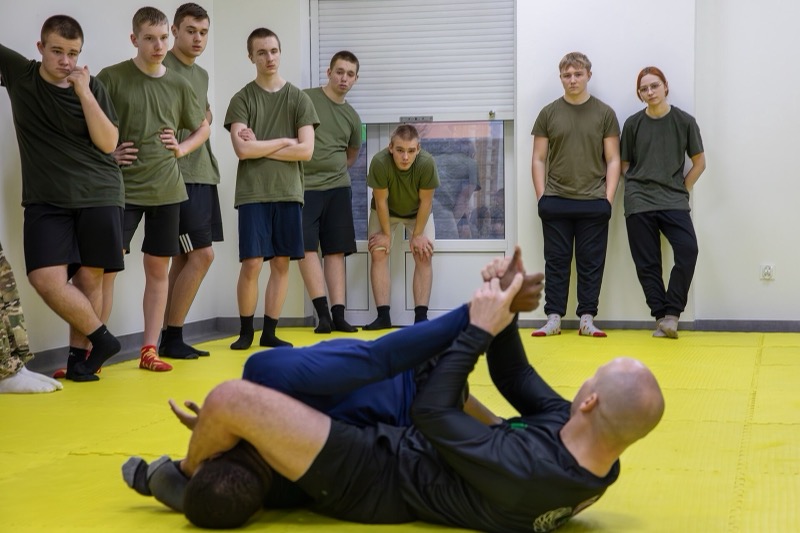
Jiu-jitsu demonstration in Torun, Poland. U.S. Army Reserve photo by Sgt. Peter Martinez. Public domain. Source
A
- Ashi garami
- Japanese for "leg entanglement" - any position where your legs control one of the opponent's legs for a leg lock.
- Americana
- A figure-four shoulder lock with the arm bent upwards, usually from side control or mount.
- Armbar
- Hyperextending the elbow with your hips as the fulcrum.
- ADCC
- The Abu Dhabi Combat Club submission wrestling championship, the most prestigious no-gi event, with its own rule set.
B
- Bridge
- Driving the hips upwards off the mat to lift the opponent. "Upa" is the Portuguese name for the bridge-and-roll mount escape.
- Base
- Your balance and connection to the mat. Having base means you cannot be swept or rolled easily.
- Body triangle
- Locking your legs in a figure-four around the opponent's torso from the back, instead of hooks.
- Back control
- Behind the opponent with hooks or a body triangle. Worth four points and the best place to finish a fight.
- Berimbolo
- Inverting under the opponent from De La Riva to spin to their back. The signature technique of modern gi jiu-jitsu.
C
- Crossface
- Driving your shoulder or forearm across the opponent's jaw so their head turns away and their spine follows.
- Closed guard
- Your legs locked around the opponent's waist. The first guard everyone learns.
D
- De La Riva
- An open guard hooking the opponent's lead leg from the outside, named after Ricardo De La Riva.
- D'Arce
- An arm-in choke from the front headlock, threading your arm under the opponent's arm and across the neck.
- Drilling
- Repeating a technique with a cooperative partner to build the movement pattern.
E
- Ezekiel
- A choke using your own sleeve fed behind the opponent's neck.
F
- Frame
- Using a bone structure (forearm, shin, knee) as a strut between you and the opponent so their weight is held away without muscular effort.
- Flow rolling
- Light, continuous sparring at low intensity where both partners let positions change freely.
G
- Gi
- The jacket, trousers and belt worn in traditional jiu-jitsu. "Gi" grappling allows grips on the fabric; "no-gi" does not.
- Guard
- Any bottom position where your legs are between you and the opponent, stopping them from pinning you and giving you attacks. Closed, half, butterfly, De La Riva and many others.
- Guillotine
- A choke from the front with your forearm across the throat.
H
- Hooks
- Feet placed inside the opponent's thighs to control or lift them - in butterfly guard from the front, in back control from behind.
- Half guard
- You have one of the opponent's legs trapped between yours. A position both players pass through constantly.
- Heel hook
- A leg lock that rotates the heel to twist the knee. Very effective and very dangerous, legal only in no-gi and at advanced belts in most rule sets.
I
- Inside position
- Having your limbs inside the opponent's - the principle that decides most exchanges.
- IBJJF
- The International Brazilian Jiu-Jitsu Federation, whose points rules are the default for gi competition.
K
- Knee on belly
- A pin with your knee across the opponent's stomach. Worth two points and very uncomfortable.
- Kimura
- A figure-four shoulder lock named after Masahiko Kimura, who used it to defeat Hélio Gracie in 1951.
- Kuzushi
- The Japanese term for breaking the opponent's balance before a throw or sweep.
M
- Mount
- Sitting astride the opponent's torso with your knees on the mat. Worth four points and the most dominant pin.
N
- No-gi
- Jiu-jitsu practised in shorts and a rash guard, without fabric grips. Faster, more wrestling-influenced and the home of most leg lock development.
O
- Oss
- An all-purpose word of respect and acknowledgement used in BJJ gyms - hello, thank you, understood, let's go. Origins are debated; usage is universal.
- Overhook
- Your arm over the opponent's arm, trapping it. Called a whizzer when used standing or in the dogfight to stop their underhook.
- Omoplata
- A shoulder lock applied with the legs from guard. "Omoplata" is Portuguese for the shoulder blade.
- Open mat
- An unstructured training session for rolling and drilling without instruction.
P
- Pass
- Getting past the opponent's legs to a pin such as side control or mount. Scores three points in IBJJF rules.
- Posture
- Head up, back straight, hips forward - the alignment that stops you being pulled into submissions from guard.
- Positional sparring
- Live rounds that start from a set position with a reset when the goal is achieved. The fastest way to fix a weak position.
R
- Roll
- Live sparring. "Rolling" is the BJJ word for sparring rounds, usually five to six minutes at a time.
- Rear naked choke
- The blood choke from the back. "Mata leão" - lion killer - in Portuguese.
S
- Sweep
- Reversing from the bottom of guard to the top. Scores two points in IBJJF rules when you end on top and stay there.
- Submission
- A choke or joint lock that forces the opponent to tap. The only way to win a match outright.
- Shrimp
- The hip escape - pushing off your feet to move your hips away from the opponent. The most important movement in the sport.
- Seatbelt
- The back control grip with one arm over the shoulder and one under the armpit, hands clasped at the chest.
- Side control
- Pinning the opponent chest to chest from the side. "Hundred kilos" is its Brazilian nickname because that is what it feels like.
- Saddle
- The leg entanglement with your legs triangled around the opponent's leg and their knee pointing up. Home of the inside heel hook.
- Sprawl
- Throwing the hips back and down to stop a takedown.
- Stripes
- The white tape bars on a belt marking progress toward the next rank. Coloured belts carry up to four; FiveStripe is named for the one you earn off the mat.
T
- Tap
- Signalling submission by tapping the opponent or the mat (or saying "tap"). Ends the exchange immediately; tapping early is how you keep training for years.
- Turtle
- Curled up on hands and knees. A defensive position that prevents points but exposes the back.
- Triangle
- A choke using your legs around the opponent's neck and one arm.
U
- Underhook
- Your arm threaded under the opponent's armpit, controlling their torso. Winning the underhook usually wins half guard and the clinch.